SWASA Busyness
How dare you? We dare!
Dear members of the UN Committee on the Elimination of Discrimination against Women,
Do not allow Campaign Pressure to Override Your Independent Mandate!
We are members of Sex Workers and Allies South Asia [SWASA] a collective advocating for the rights, dignity, safety and agency of sex workers across South Asia, championing inclusion, equality, freedom from stigma and discrimination, and meaningful participation in policies that affect our lives.
The “How Dare You?” campaign raises issues that deserve to be heard, and survivor testimonies must be addressed, but it must happen alongside the experiences and rights of women in sexual service provision whose perspectives differ.
CEDAW General Recommendation No. 38 already provides a strong legal foundation for addressing trafficking in women and girls, sexual exploitation, gender-based discrimination, economic vulnerability and the demand that fuels trafficking.
We stand for a CEDAW Committee that is courageous enough to listen, rigorous enough to scrutinise its own conclusions, and independent enough to make decisions on their merits.
We respectfully urge the Committee to:
- Stand firm in its independence.
Any reconsideration should follow a transparent, substantive assessment of the evidence, applicable law and human-rights implications. - Hear all affected women.
Engage meaningfully with survivors of trafficking and sexual exploitation, as well as women who currently provide sexual services, and who identify as sex workers. - While women may be decriminalised as individuals, the criminalisation of their work cannot ensure substantive safety, dignity, or the full realisation of their rights.
CEDAW must ensure that no woman is abandoned, silenced or deprived of protection because of the terminology used to describe them.
Examine the evidence.
Uphold the Convention.
Do not let pressure replace principle.
SWASA Busyness
Sex Workers and Allies South Asia-SWASA at AWID Forum 2024
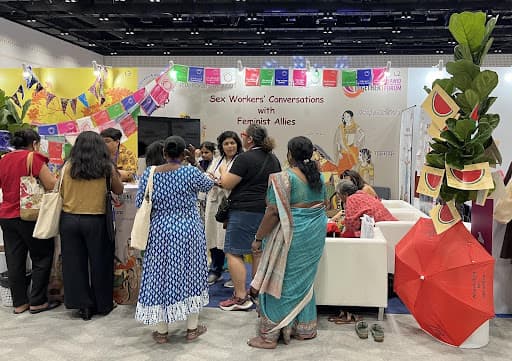
From December 2-5, 2024, in Bangkok, Thailand, Sex Workers and Allies South Asia (SWASA) hosted Sex Workers’ Conversations with Feminist Allies at the AWID Forum 2024. This dynamic space provided an opportunity for feminists from across the world to visit the SWASA Lounge, engaging in lively discussions about sexuality, decriminalization demand, the intersection of feminism and sex work, cultural and religious perspectives, and the broader themes of women, work, and sex work.

SWASA Village @ Renew
The SWASA Village, held during the @Renew: South Asia Sex Workers Summit by CREA from 29 to 31 May 2024, at Arboretum Park, Park Village Resort, served as a crucial platform for advocacy for Sex Workers and Allies South Asia (SWASA). The village brought together grassroots activists to engage in meaningful discussions, share experiences, and form lasting connections. Over the three-day event, a total of 300 participants visited the village.
The primary objectives of the SWASA Village were to advocate for the rights of sex workers, provide updates on relevant developments, and foster a sense of solidarity among participants. The themed sessions at the SWASA Village, covering “Sex Work University,” “River of Submissions,” and “Cross-movement Adda”, along with the all-day Mandi (marketplace) and Village Plaza, contributed to a dynamic and engaging environment. These activities facilitated focused conversations and strengthened the community’s network, achieving the village’s advocacy and community-building goals.


SWASA at World Social Forum, 2024

Society controls sexuality and sexual expression in many ways, particularly the sexual and reproductive rights of women and persons from diverse sexual orientations and gender identities. Heterosexual people are also affected by these controls. The state, family, community, caste, and clan play a central role in controlling sexuality. The market economy also controls sexuality.
The silence around sexuality has been broken with the spread of the HIV epidemic. Sexual minorities, sex workers and people living with HIV have been pushed to the margins by a society that has condemned their very existence. According to a 2020 UNAIDS report, 92 countries said that they criminalized HIV non-disclosure, exposure, and transmission through either specific or general laws. Such laws are counterproductive because they undermine efforts to prevent new HIV infections. The HIV epidemic has forced societies to acknowledge and confront the complex world of people who are in monogamous relationships within and outside marriage, as well as people who are in multiple sex partnerships within both commercial and non-commercial contexts.